Tuesday, 14 October 2025

Appreciation of the poem sower

 Victor Hugo: Poet, novelist and dramatist of the 19th century was the most important of the French Romantic writers. Though regarded in France as one of the country’s greatest poets, he is better known for novels as “Notre-Dame de Paris”(1831) and “Les Miserables”(1862

Torulata Dutt: A Bengali poet, also known as Toru, wrote in English and Fench, was born on 4th March 1856 in Kolkata. She is considered to be ‘The first Indian poetess’ to write verses in English and French. She translated dozens of poems and completed a novel before her death at the age of 21. Her poems such as ‘Seeta’, ‘Lotus’ and ‘Our Casurina Tree, are well-loved.

‘The Sower’ is a translation of Victor Hugo’s poem, Saison des Semailles: Le Soir. It is translated by Toru Dutt from French to English. ‘The Sower’ is a poem about a farmer who is sowing seeds. He has seen many bad harvests in his life. However he is so optimistic of having a good harvest every time he tosses grain.

Poem:
1

Sitting in a porchway cool,                                                                                  
Fades the ruddy sunlight fast,
Twilight hastens on to rule–
Working hours are well night past
2
Shadows shoot across the lands;
But one sower lingers still,
Old, in rags, he patient stands,–
Looking on, I feel a thrill.
3
Black and high his silhouette
Dominates the furrows deep!
Now to sow the task is set,
soon shall come a time to reap.


4

Marches he along the plain,
To and fro, and scatters wide
from his hands the precious grain;
Moody, I, to see him stride.
5
Darkness deepens. Gone the light.
Now his gestures to mine eyes
Are august; and strange–his height
seems to touch the starry skies.


The Sower Appreciation
Appreciation: The Sower Appreciation

About the Poem, Poet, and Title

The Sower, poem is written by the great French poet Victor Hugo. The poem is translated from French to English by Bengali poet Torulata Dutta. The poem is about the sower, who is a hardworking farmer. In the poem, the poet gives reverence to the sower who is working still the time of evening while others are moving to their home. The title of the poem (The Sower) is apt and suitable to the theme of the poem because the poet talks about the sower and his determination to hard work. 
Theme/summary/gist of the poem


The theme of the poem is about the sower who is working in his field still the time of evening. In the poem, the poet is watching the working figure of the sower. The people are moving towards their home because working time is almost over but the sower is still working in his field. The poet sees the appearance of the sower, who looks old and poor.
The poet tells that it is the time of sowing and that’s why the sower has set a target to complete the sowing target. The sower knows that in time if he sows the grain, soon the harvest will come. In such a thought the sower is sowing the grain on his farm even if it is time to go home but still he is working on his farm. By watching such activities of the sower the poet feels how noble and dignified the sower is!
 Poetic style/language, poetic devic

The poem is written in simple and lucid language. The poem is a short poem that consists of five stanzas. The poem has fine rhyming pairs, which are as follows- cool-rule, fast-past, lands-stands, still-thrill etc. the rhyming scheme of the poem is abab,cdcd,efef etc. The poet uses fine figures of speech to increase the beauty of the poem; these figures of speech are Alliteration, Personification, Inversion, Antithesis, Repetition and Hyperbole.
Special features/novelties/focusing elements

The poem is about reverence for the farmer of the universe. The poet tells the worst condition of farmers by the example of the sower. The poet shows the dedication and determination of farmers related to the work and farmers have to work within a stipulated time and then they will get a good harvest on time. The poet has used word imagery to show the greatness and dignity of the sower. eg: “his height seems to touch the starry skies.”
Message /value/morals in the poem

The poem, The Sower gives the message of perseverance, hard work and dedication towards our goal and target. Through the experience, we will definitely achieve the things in our life. The poet set out the example of the sower to the readers that we should always be optimistic in life. the final message of the poem is not to lose our hopes and should be optimistic in life.
Your opinion about the poem

I like the poem very much because the sower mentioned in the poem is always optimistic about having a good harvest every time he sows seeds on his farm. We should always be optimistic while doing any kind of work in our life. I am impressed by the poet’s keen observation of the working figure of the Sower. The poem The Sower is the best example of hopefulness and dedication in our work.


there is another sky by Emily dickinson appreciation

Emily Dickinson (1830-1886) is an American poet of the nineteenth century. Her poems are very motivational and highly philosophical about life. Emily Dickinson’s poems are characterized by simple and short lines.

The poem is highly motivational and philosophical about life. In the poem, the poet is communicating with her brother Austin and pleads with him come to home back. She encourages her brother that there are always other opportunities, options, places, and choices in your life so; don’t be get depressed in your life if you face any difficulties or failures. She pleads to return home. Here are so many things to do in your life.

There is another sky the tile of the poem is a metaphor itself. The sky is indirectly compared with choices, opportunities, places, etc. it means in our life there are always other (second) options to do.

Theme:
There is another Sky is an inspirational poem. Poet motivates her brother to not get depressed under any worst situation because there is always another option in your life, there is another opportunity to take, there is another place to go where you feel the peaceful and fair atmosphere ever. Poet suggests that always be optimistic in our life.

Poetic style, language, poetic devices:
It is a Petrarchan sonnet that consists of fourteen lines with octave and sestet. The language of the poem is simple and short. It has only two stanzas, the first stanza consists of eight lines and the second stanza consists of six lines. In the poem, the poet has used a number of devices to express her inner feelings as well as poetic effects with Alliteration, metaphor, personification, antithesis, onomatopoeia, hyperbole, inversion, etc.

Special features:
Poet has used nature imagery in the poem. Little forest, faded forests, green leaf, unfading flowers, brighter garden such nature imagery shows the beauty and their references used by the poet to make an impact on the reader.

Massage/morals in the poem:
The poem has an optimistic tone. Poet suggests that always be optimistic in life. Life is full of challenges; one should face the challenges with a positive attitude. Don’t be upset or regret under any worst situation, there is another good option to choose, there is another opportunity in your life and there is another sky.

Your opinion about the poem:
I am really impressed and inspired by reading this poem. I understood the importance of life and always being optimistic in our life, whether any difficulty, problem, or worst situation will come in our life do not get depressed, upset, or regret. We should live in hopefulness that there is another opportunity, choice, or place in our life. There is another sky in our life.


appreciation of Cherry tree

About the Poem, poet, and title
The poem, the Cherry tree is written by the great poet Ruskin Bond. The poem is about the poet’s inner feelings about the cherry tree that he planted in the thought of growing the cherry tree on his own and taking care of himself. The title Cherry tree is very apt and suitable because the poet shows the development and growth of the cherry tree and its struggles. The poet mentioned each stage of growth of the cherry tree that’s why the title is apt to the poem.
Theme/summary/gist of the poem
The subject matter of the poem is about the poet’s love and attraction toward nature. The poet thought to plant the cherry tree and in such thought the sow the cherry seed. Poet shows the stages of growth of the cherry tree. The poet mentioned the threats of the cherry tree and how the cherry tree struggled to survive and nature has its way to grow itself. At the end of the poem, the poet shows the beautiful scenery of the cherry tree and its surrounding.
Poetic style/language, poetic devices
The poem, the Cherry tree is a narrative poem. In the poem, the poet tells the story of the growth of the cherry tree and its struggle. The language of the poem is very simple and narrative. In the poem, the poet increased the beauty of the poem by using the figure of speech as Alliteration, Antithesis, Personification, climax, etc. the poem has rhyming words that give rhythmic quality to the poem. The rhyme scheme of the poem is aa, bb, cc, dd, ee,ff, etc.
Special features/novelties/focusing elements
The poem is a nature poem. It has fine nature imagery used by the poet. The poet shows the stages of growth of the cherry tree as the life stages of a human being. In the poem, the poet shows how nature grows itself without taking by anyone. The poem has fine picturesque quality by showing the nature image and scenery.
Message /value/morals in the poem
The poet gives the message that we should take of nature; at least we should plant a tree and take care of it. The poet urges that to do tree plantation conservation of nature. if we take care of nature, nature will take care of us.
Your opinion about the poem
I am really impressed by the poem and the poet’s thoughts. It has a positive and hopeful tone in the poem. The poet’s thoughts encourage me to plant at least one tree and take care of it. From the struggle of the Cherry tree, we should take the lesson that in any situation we should be always positive and hopeful. After every worst or dark situation, there will be a better and bright future ahead. If we face the problems, and obstacles positively victory is sure. Thus, I like the poem and its optimistic tone of life. 
:


Tuesday, 24 December 2024

speech Writing


6 Important Speech Writing Examples


Speech Writing
Read the following speeches and be competent about Speech Writing skill.

Speech Writing Examples
Table of Contents

1.Speech Writing : World Literacy Day
2.Speech Writing : Students’ Day
3. Speech Writing :  SAVE ENVIRONMENT SAVE HUMAN BEING .
Speech Writing : How to achieve success in life?
Speech Writing : Teacher’s Day ,5th September.
Speech Writing : Children’s Day
Speech on Dr. Babasaheb Ambedkar
1.Speech Writing : World Literacy Day
Good evening, honourable dignitaries of the dais, the president of the function hon. Mr. B.B. Patil, hon. Principal,  Mahatma Gandhi College of Science, Gadchandur, respected teachers, dear friends,  Today the 8 th September is being celebrated as the World Literacy Day all over the world. As per the report of the global monitoring, it has been observed that one among every 5 men and two third women are illiterate. Hence, to increase the literacy rate World Literacy Day is celebrated. Isn’t literacy a basic need in this modern age? Literacy is a wide open door to knowledge . In an earlier era literacy was considered a privilege of upper classes and sin for the masses. With the efforts of revolutionary social workers, the closed windows and doors of knowledge, education, and literacy were flung open. Today we breathe democracy almost all over the world. Other forms of government in the world also opened the doors of education and literacy. The importance of literacy is far beyond the imagination. The spread of literacy among the women of the world is not at par. The awareness programs for this have to be organised. Celebrating World Literacy Day can be a part of it. The real celebration will be on that day when no woman is deprived of education. I have to conclude my speech here. Thanks for the availing opportunity of being part of this grand program.

2.Speech Writing : Students’ Day
Respected Principal, honourable teachers and dear students, I feel proud to speak on such a great occasion.  We are gathered here to celebrate  November 7 as ‘Students’ Day’, to mark Dr B R Ambedkar’s entry into school education 117 years back in 1900.  Babasaheb’s  enrollment in school was the dawn of a new era. It was because of the Constitution given by Dr Ambedkar to the nation that the values of freedom, equality, brotherhood and rule of law took roots in the society.Hence the enrolment of Dr B R Ambedkar as a student in the school is a landmark event and proves to be one that changed the course of our history. Dr Ambedkar was a life-long student and cultivated his interest to learn throughout his life. Friends,it is rightly said that every student is the future of the country and education is the only means for progress.The very purpose of observing this day as Students’ Day is  to make the students aware that hard work alone can ensure their progress.Dr Ambedkar enrolled as a student on November 7, 1900 at Pratapsingh High School in the state’s Satara district.He started his schooling in a hostile condition. He set an example for students how much,how far and how long one can study. He is an inspiration for all . Nothing can prevent me from studying. Should we give excuses for not preparing due to power failure? My dear colleagues, Babasaheb used to study sitting under the lamp post. Who doesn’t know this ? Being a student I am very much delighted to be a witness of Students’ Day celebration. I have to take leave of you as many other students are going to share their views. Thanks for listening to me peacefully.

3. Speech Writing :  SAVE ENVIRONMENT SAVE HUMAN BEING .
     ——————————————–

Honourable  chairperson, chief guests, and the dignitaries as well as the most respected dear students .

      Friends, we commemorate so many special days such as Republic day, Independence day, World literacy day and so on . But well here is one day that deserves  not only commemoration but our total dedication — World Environment Day, 5 June .Today we are celebrating World Environment Day in our college. As students we all know the importance of the day. Every year on this day  we celebrate the programme in our college to create awareness  in the minds of  our friends , neighbours , our companions and those who live in our surroundings . 

 friends our mother earth has made our life worth living,  trees and plants provide us everything .Not only oxygen but also everything ,you name it and you will find its source in the nature .friends  we have learnt the poem ‘The felling of the banyan tree ‘.We learnt that how the devotees of materialism have ruined the beauty of the nature, they have not only ruined the beauty of the nature but also polluted the atmosphere of the world .I’m saying here ‘the world ‘ because they are many in number . In this poem we learnt fifty men chopped the trunk of the tree, through this we can measure the intensity  of their  destructive attitude , really it is a fearful thing no less horrible . And if it goes on ….. one day we will have to leave this world forever .

    Friends ,  think of our next generation . Today we say that had our ancestors paid heed to the family planning like programmes we would not have to face the problems we are facing today.   But whatever it may be , we have to set things straight . Today we all have to make a commitment to plant as many trees as we can. And let’s take care that they  are grown.

Make awareness about it .Mobilize people for this greater cause. Friends, it’s not the environment you will be protecting  … You are protecting your own life and the lives of your beloved ones.

  Thank you  …

Speech Writing : How to achieve success in life?
Honourable dignitaries on and off the dias, respected judges, curious audience , I would like to express my views on the  topic which is close to everyone’s heart i.e. ‘How to achieve success in life ‘ . It’s a pleasure to see such a huge audience here. I recall some lines here.

    “The woods are lovely, dark and deep,

    But I have promises to keep

    And miles to go before I sleep

   And miles to go before I sleep “

Friends, as you know there is no shortcut to success . To achieve success you need proper guidance. You should have a clear view of the success you want. So set the goal you want to achieve. Dedication towards the goal is an important factor. Nothing can be gained without it. In achieving success, planning plays a crucial role. Plan your work and execute it accordingly. Well planned  is half done. You need to read the successful stories to get inspired. Shouldn’t we follow successful people ? The most important thing to pursue the goal is knowledge and information without which the goal will be fruitless. Get the knowledge from all the sources. Collect essential information about the goal you have set.

Is there anything impossible? The word ‘impossible’ itself says I’m possible. Working with passion and confidence will gear you towards success. Remember, hard work is the key to success. In the journey of success on  many occasions, your have to sacrifice some petty things . Never give up attitude and perseverance are the two weapons to win success. Believe in your efforts, success will be yours. I would like to wind up speech. Thanks for the patience you have shown during my entire speech. I would like to say thanks to the organiser for organising the elocution  contest.

Thank you everyone. 

These different topics on speech Writing will help students to write their own speech and make their speech Writing skill efficient.

Expansion of Ideas

Speech Writing : Teacher’s Day ,5th September.
Good morning to one and all and my greetings to all my respected teachers. Honourable chairperson,the Principal of our college,Mr./Mrs ……….., respected teachers and my dear friends.Today is an auspicious occasion to honour and acknowledge the contributions and hard work of teachers who mould the students into the future citizens.Guru Pournima is also celebrated to express our gratitude towards our Gurus.
     Friends, Can you tell why 5th September is celebrated as Teacher’s Day?Yes,it is celebrated throughout the country since the year 1962 on the birth anniversary of Dr.Sarvapalli Radhakrishnan,the second President of free India.He was born on 5th September 1888 at Tiruttani,in Tamil Nadu State.He was a great philosopher, educationist and a teacher by profession.When he became the second President of India,few of his students requested him to let them to celebrate his birthday on 5th September.On this request,he asked them to celebrate his birthday as Teacher’s Day and not just as birthday.Ever since this day is celebrated as Teacher’s Day every year.
      Our education begins at home. Mother is our prime teacher.As we grow and meet different people,we learn many things from them.Everyone around us teaches us something.Experiences and mistakes are also our great teachers.
     In olden times,there was Gurukul System of teaching where the students left their homes to stay with the sages in the forest for years. After completing the training,the students returned homes.Those  sages were worshipped and honoured by the students and their parents like God.Since then a teacher is placed next to God.That’s why it is said,


*Gurur Brahma,Gurur Vishnu,
Gurur Dev,Maheshwara.
Gurur Sakshat ,Parbramha.
Tasmai Sri Guruve Namaha.*


      It means Guru is the Lord himself.Gurus/ teachers are next to God.So,Gurus are worshipped on Guru Pournima.
    Teachers are our second parents because they take care of us as parents.They show us right path as the beacon light.They are like candles who spend their whole life in giving light to the students .They are always with us whenever we are in trouble whether it is academic or personal.They are the nation builders.They guide and shape the destiny of students.Teachers teach us to become better human beings.Sometimes , teachers scold us but there is their love and affection towards us behind their scolding.They scold us for our betterment.Teacher is the profession that creates all the professions like doctor,engineer, advocate, Chartered accountant and so on.
     Teachers like Dr Radhakrishnan ,Sane Guruji and Dr.APJ Abdul Kalam are some of the renowned names that have given meaning to the word in the world of teachers. In mythology we find many examples of Gurus and deciples such as Dronacharya and Eklavya, Sandipani and Shrikrishna etc. Eklavya is known as an ideal student.When Guru Dronacharya refused to teach archery to Eklavya because he was Shudra,(because Shudra was considered as the lowest category in the society at that time.) Eklavya built the mud idol /statue  of Dronacharya and practised archery before it and became the skilled archer equalled to Arjun.
On seeing the skill of Eklavya in archery,Guru Dronacharya  was astonished. He asked for Eklavya’s right thumb as Guru Dakshina because he didn’t want Eklavya to excel Arjun.And without thinking so much, Eklavya cut off his right thumb and put it at the feet of his Guru.It shows his reverence towards his Guru.Eklavya still continued to practise archery with the forefingers and middle fingers and remains as an example of an ideal student till today.We should also keep Eklavya as a role model before us and gain the knowledge.We should concentrate on our target like Eklavya.
   Today,we are living in the age of science and technology.We learn many things through various apps.We get vast knowledge through internet but as per my opinion, no one can replace the teachers because teachers not only give us knowledge but also shape our personality by teaching many moral lessons.Apart from academic,they stand by us at every step to guide ,motivate and inspire us to become good citizens.
   We are proud to say that we are being cultivated by the finest gardeners. We pray for their well beings and good health.I would like to express my gratitude towards all teachers for their selfless and dynamic support.We are always grateful to you.I conclude my speech by wishing you Happy Teacher’s Day


Thank you.

Speech By Vaishali Jane.
Principal ,
Ajabrao Wankhede Jr.College,Kohli .Tal.Kalmeshwar ,

Dist. Nagpur.

Speech Writing : Children’s Day
Draft of Speech Writing is by Vaishali Jane


A very good morning to everyone and happy children’s day to all my dear students. Honourable Chairperson,the Principal of our college Mrs Smita Chitade, my dear teachers and my dear students.Today,we have gathered here to celebrate the birth anniversary of our first Prime Minister, Pt. Jawaharlal Nehru.
Friends, is there anyone who doesn’t know Pt. Nehru and his achievements ? He was quiet popular among children. He is called as Chacha Nehru. Because of his love for children, the government celebrate his birthday as Children’s Day.Friends, Can you tell me why he always pinned the rose to his coat?Yes,he pinned the rose in memory of his wife Kamala Nehru who died in 1938 after a prolonged illness.
Well ,Pt.Nehru was born on 14th November 1889 in Allahabad.His father Pt.Motilal Nehru was a lawyer by occupation.His mother’s name was Swarup Rani.He was rich enough to get the best education.He received his early education at home under private tutors.Later on he was sent abroad for studies at the age of 15. In England he got his education from two universities ,namely Cambridge and Harrow.After getting the degree, he started his legal practice in Allahabad High court.He married to Smt. Kamala Devi at the age of 24. Friends,
Well,he was interested in politics. He was a man of peace but when he saw how the Britishers treated Indians,he decided to join the freedom movement.He shook hands with Mahatma Gandhi,the father of the nation and joined the non -cooperation movement. During the freedom struggle,he faced many challenges.He was imprisoned numerous times.When he was in Almora jail,he completed his autobiography named Towards Freedom on 14th February 1935.He also wrote the book entitled Discovery Of India .He wrote 30 letters to his daughter,Indira Gandhi.All those letters were printed as a book under the title Letters From A Father To His Daughter Friends,it shows that he was a great writer.
He was presided over the historic session at Lahore (Now it is in Pakistan) where he proclaimed complete Independence as India’s goal.After becoming the first Prime Minister of India,he had played a significant role in the establishment of modern India.He developed his Panchsheel Tatwe from Buddist thoughts.He based India’s Foreign Policy on these five priciples.
Friends,on seeing the work of Pt Nehru,we come to know that he was a man of extraordinary vision.He was a great leader, politician,writer,orator,and freedom fighter.He is known as an Architect of India.He always worked hard for day and night for the betterment of the country and its people.Most noteworthy,he gave the slogan Aram Haram Hai which simply means Rest Is Not Best.
We should also keep this slogan in our mind and work hard for achieving our goals and serve the motherland like him. You,Childern are tomorrow’s future of the nation.You have hidden talent and creativity. Rastrasant Tukodoji Maharaj says ,”या कोवळ्या कळ्यामाजी | लपले ज्ञानेश्वर, रवींद्र, शिवाजी | विकसता प्रगटील समाजी | शेकडो महापुरुष |” It means many great personalities are hidden inside you, children.Only you need proper guidance and nourishment.Friends, I hope you understand the importance of this day very well.So,follow the principles of such great leader and develop yourselves as well as do something great for the betterment of our motherland.
I conclude the speech by paying my humble tribute to this great son of India.
Thank you for listening my speech patiently.
Jai Hind!

Unity in Diversity

Speech on Dr. Babasaheb Ambedkar


Good morning/afternoon, respected dignitaries, teachers, and my dear friends,

Today, I am honoured to speak about one of India’s greatest leaders and social reformers, Dr. Babasaheb Ambedkar, the architect of the Indian Constitution and a symbol of justice, equality, and social empowerment.

Dr. Bhimrao Ramji Ambedkar was born on April 14, 1891, in Mhow, Madhya Pradesh, into a Dalit family. From an early age, he experienced the harsh realities of caste discrimination, which deeply shaped his vision for an inclusive and equitable society. Despite facing immense challenges, Ambedkar pursued education with determination, earning multiple degrees from prestigious institutions like Columbia University and the London School of Economics.

Dr. Ambedkar’s contributions to India are unparalleled. As the principal architect of the Indian Constitution, he ensured that it guaranteed fundamental rights, social justice, and equality for all citizens, regardless of caste, creed, or gender. His efforts laid the foundation for a modern and democratic India.

Beyond his role as a constitutional expert, Dr. Ambedkar was a tireless advocate for social reform. He dedicated his life to eradicating untouchability and fighting for the rights of marginalized communities. Through his writings, speeches, and leadership, he inspired millions to stand against oppression and work towards a more just society.

Dr. Ambedkar also emphasized the importance of education as a tool for empowerment. He famously said, “Cultivate the mind, without fear and without prejudice.” He believed that education was the key to breaking the chains of inequality and creating opportunities for all.

Another remarkable aspect of his life was his relentless advocacy for women’s rights. He championed equal rights for women in terms of property, education, and employment, recognizing their vital role in building a progressive society.

Dr. Ambedkar’s legacy goes beyond India. He stands as a global icon of social justice and human rights. His teachings continue to inspire movements for equality and dignity around the world.

As we reflect on his life and achievements, let us draw inspiration from his unwavering commitment to justice, his belief in the transformative power of education, and his vision of a society where everyone has an equal opportunity to thrive.

In conclusion, Dr. Babasaheb Ambedkar’s life is a testament to the power of perseverance, courage, and the pursuit of justice. Let us honor his legacy by upholding the values he fought for and working towards a society where equality and humanity triumph over discrimination and prejudice.

Thank you.


Tuesday, 1 October 2024

the Sign of four

 
The Sign of the Four begins at the Baker Street home of the infamous detective, Sherlock Holmes, and his assistant, Dr. John Watson. Holmes is a little bored, having no case to work on, and is injecting himself with cocaine—Watson disapproves of this bad habit.

Soon enough, the beautiful Miss Mary Morstan arrives at the flat asking for Holmes’ help. She outlines her case. Her father, Captain Morstan, had been an officer in the British Army and was stationed in India; she was at boarding school in Scotland. Ten years ago, he came back on leave, but as soon as he arrived in London he disappeared without a trace. A few years ago, she started receiving pearls in the mail once a year after answering an advert in the paper calling for her address. The pearl she has recently received came with a note, instructing her to go to the Lyceum Theater in London’s West End that evening, where somebody will come to meet her. Holmes and Watson agree to accompany her. Throughout Miss Morstan’s story, Watson can’t help but admire her.


The Sign of the Four begins at the Baker Street home of the infamous detective, Sherlock Holmes, and his assistant, Dr. John Watson. Holmes is a little bored, having no case to work on, and is injecting himself with cocaine—Watson disapproves of this bad habit.

Soon enough, the beautiful Miss Mary Morstan arrives at the flat asking for Holmes’ help. She outlines her case. Her father, Captain Morstan, had been an officer in the British Army and was stationed in India; she was at boarding school in Scotland. Ten years ago, he came back on leave, but as soon as he arrived in London he disappeared without a trace. A few years ago, she started receiving pearls in the mail once a year after answering an advert in the paper calling for her address. The pearl she has recently received came with a note, instructing her to go to the Lyceum Theater in London’s West End that evening, where somebody will come to meet her. Holmes and Watson agree to accompany her. Throughout Miss Morstan’s story, Watson can’t help but admire her.

Get the entire The Sign of the Four LitChart as a printable PDF.
The Sign of the Four PDF
Later that evening, Holmes, Watson and Miss Morstan head to the meeting point. On their way, Miss Morstan shows Holmes a paper she found in her father’s desk. It appears to be a map, with a red cross drawn on it. Beside the cross, the paper reads: “the sign of the four – Jonathan Small, Mahomet Singh, Abdullah Khan, Dost Akbar.” At the Lyceum Theater a carriage is waiting for them and takes them to the house of the anxious Thaddeus Sholto, the son of Major Sholto, who was Captain Morstan’s friend and colleague in India. Thaddeus explains that Captain Morstan is dead; he died from a heart attack when arguing with Major Sholto about the Agra treasure. Thaddeus explains that this treasure, part of which he says is rightfully is Miss Morstan’s, is an immense collection of jewels. His father fell ill a few years previously after receiving a letter from India that caused him a great shock. Thaddeus notes that his father had a fear of men with wooden legs. On his deathbed, Major Sholto was about to reveal the location of the Agra treasure when a bearded man appeared at the window; the shock killed Major Sholto. The next day, Thaddeus and his brother, Bartholomew, discovered that Sholto’s belongings had been searched and a note reading “the sign of the four” was left on the body. Just before he died, Major Sholto instructed his sons to share some of the treasure with Miss Morstan and gave them pearls to send to her. Thaddeus then informs his visitors that Bartholomew has located the treasure at the family home, Pondicherry Lodge; all they need to do now is head over there and divide it up.

When the group arrives at Pondicherry Lodge, they find the housekeeper, Mrs. Bernstone, in an agitated state. She says that Bartholomew has not left his attic laboratory all day. Holmes and Watson look through the keyhole and see Bartholomew’s face grinning back at them, unnaturally still. They break in and confirm that Bartholomew is dead; he seems to have been killed by a poisonous blow dart. Holmes investigates the scene, concluding that the assailants are a wooden-legged man and a short accomplice. The treasure, too, is nowhere to be seen. Holmes suspects the main culprit to be Jonathan Small, one of the “sign of the four” signatories. As Athelney Jones, the hapless Scotland Yard detective, arrives, Holmes sends Watson to fetch Toby the hound so that they can track a scent from the scene—it appears that the wooden-legged man stepped in creosote in his rush to escape. Watson drops Miss Morstan at home on his way, feeling his affections towards her increasing.

Holmes and Watson trek around London, following Toby the hound. At one point, the dog leads them to a pub’s creosote store, much to their amusement. Toby then picks up the original scent again and leads them to the Thames. Holmes talks to a local woman and gleans that the criminals must have hired a boat from Mordecai Smith called the Aurora—a speedy steam launcher. He tricks her into giving a description of the boat.

In order to trace the vessel, Holmes hires a group of street urchins to search London. They have no luck, so Holmes, increasingly agitated at the lack of progress, disguises himself as a sailor and makes his own inquiries around London. When he has a breakthrough, he instructs Athelney Jones to meet him at his flat. Jones waits for Holmes in Watson’s company, before the two are interrupted by an old man who claims to know the solution to the case. The old man is only willing to speak to Holmes and makes to leave when he learns that Holmes is elsewhere; Jones and Watson entrap him in the flat. Suddenly, the old man reveals himself to be the delighted Holmes in disguise. Holmes explains that he has tracked the Aurora down to a shipyard, where it awaits Jonathan Small and his accomplice, who will attempt to escape that evening with the help of Mordecai Smith.

Later that night, Holmes, Watson, Jones and some police officers board a police boat in order to give chase to the Aurora. Holmes has stationed a boy at the shipyard who will give a signal when the Aurora is leaving. Soon enough, Small and his accomplice, Tonga, attempt to escape with Mordecai Smith at the helm. Holmes and the others begin the chase; when Tonga, a small “black cannibal,” prepares to shoot at them with a blow dart, Holmes and Watson fire the guns at him. Tonga, dead, falls into the river. The Aurora runs aground and Jonathan Small is captured. The Agra treasure appears to have been recovered, so Watson delivers the treasure chest to Miss Morstan, only for them to discover that it is empty. Watson is relieved because he feels that Miss Morstan’s riches would have made her inaccessible to him. Miss Morstan is not upset about the treasure, and they embrace.

Jonathan Small is taken back to Baker Street and asked to tell his story at Holmes’ request. Before he does so, he explains that he has scattered the treasure in the Thames; if he can’t have it, he doesn’t want anyone else to. Small then tells his story. He was stationed in India with the British Army. Soon after arriving there, his leg was bitten off by a crocodile. When the Indian Mutiny began (the locals rose up against their British authorities), Small worked as a guard at the ancient fortress of Agra. He was in charge of two men, Mahomet Singh and Abdullah Khan, who convinced him to join with them in seizing treasure from a merchant acting on behalf of an Indian prince. Along with Abdullah’s cousin, these men made up the “sign of the four” and pledged allegiance to each other. They killed the merchant and acquired the treasure, a rich bounty of various jewels. It was then hidden in the Agra fortress to be retrieved when the country had calmed down a little. Though the tensions did die down soon enough, Small and the others were arrested for killing the merchant and subsequently sent to a prison camp on the Andaman Islands. At the prison camp, Small made the acquaintance of the overseers Major Sholto and Captain Morstan, and hatched a plan to share the treasure with them in exchange for his escape. Sholto double-crossed everyone and took the treasure for himself back to England. During this time, Small befriended Tonga, a native of the island, nursing him when he was sick. Tonga became extremely loyal to Small and helped him to escape.

The two men eventually made it back to England, where for a time they survived by displaying Tonga in freak shows. Small tracked down Sholto just before he died and left the note on the Major’s body. He had an inside contact at Pondicherry Lodge who informed him that the treasure had been discovered. With this knowledge, he and Tonga went to the house to get the treasure; Tonga entered the house first, killing Bartholomew without checking with Small first.

Holmes is satisfied he has learned all there is to know about the case. Athelney Jones thanks him for his help and leads Jonathan Small away. Watson informs Holmes that Miss Morstan has agreed to marry him. Rather than offer congratulations, Holmes explains that he believes “love is an emotional thing, and whatever is emotional is opposed to that true cold reason which I place above all things.” Holmes reaches for his own comfort: the cocaine bottle.


Tuesday, 24 September 2024

have you earned your tomorrow

Summary of the poem
The poem ‘Have you earned your tomorrow?’ begins with two direct questions. The poet asks the readers if they have made someone’s day better and had nice conversation with other people so that they can remember them. The poet hints that time is running fast.  He asks if their good conduct with someone has made the other person say kind things about them, at the end of the day.

In the II stanza the poet further asks the readers if a friend who came face to face was greeted cheerfully or impolitely without bothering to show any concern. He wishes to know if the readers were selfish as they rushed through the day. This behavior is disapproved by the poet. He asks to recall whether the readers comforted someone & if the person was grateful to them for that gesture.

In the III stanza, the poet asks the readers if they were kind, at least to one single person whom they met that day. At least one person was given joy, made happy because of their actions and deeds. He wishes to know, whether any hopeless man was encouraged to lead a better future.

In the last stanza, the poet wishes to know how the entire day was spent. If the day was wasted or lost and spent unhappily without improving the lives of others. He wishes the readers to reflect upon their negative actions. If there was kindness shown to others, definitely it will urge these people to repeat the action to others. This will begin in creating a kindness chain, a kindness cycle throughout the world.

In the end, the poet asks the readers to recall by closing their eyes while sleeping and thinking about God’s reaction to their actions for the day. If the day was spent in doing kind deeds to others, God’s response will be a positive one. They can be assured of a better tomorrow. The good that is done today, definitely earns us our tomorrow. The good work we do today, assures us hopeful future.

Figures of speech –

1] Alliteration – Consonant sound repeated in successive words for musical effect.      

– This day is almost over, and its toiling time is through

– Or is someone mighty grateful for a deed you did today?

– Did you waste the day or lose it, was it well or sorely spent?

– And then vanish in the throng.


2] Synecdoche – (A part of something that stands for the whole thing)

– Is a single heart rejoicing over what you did or said;


3] Interrogation – (The question is asked not to obtain an answer but to emphasize a certain point)

– Is anybody happier because you passed his way?

– Does anyone remember that you spoke to him today?

– Is there anyone to utter now a kindly word of you?

         – Did you give a cheerful greeting to the friend who came along?

         – Or a churlish sort of “Howdy” and then vanish in the throng?

         – Or is someone mighty grateful for a deed you did today?

         – Does a man whose hopes were fading now with courage look ahead?

         – Did you waste the day or lose it, was it well or sorely spent?

         – Did you leave a trail of kindness or a scar of discontent?

         – You have earned one more tomorrow by the work you did today?

Rhyme Scheme of the poem is aabb


Friday, 6 September 2024

call of the soil


Chapter 1.3: The Call of the Soil Balbharati solutions for English Yuvakbharati 11th Standard Maharashtra State Board

1.3 The Call of the Soil

A Scent of Rice

Ice Breakers


Activity:- Discuss the following with your partner and complete the following sentences. One is done for you.


(a) Before eating apples brought from the market, I wash and peel them off. 


(b) In a farmers’ market, we find vegetables and fruits.


(c) Food adulteration means adding a small quantity of non – nutritious substances intentionally to improve the appearance, texture or storage properties of the food.


(d) Organic food is grown by using natural materials, methods and conditions. 


(e) Organic fertilizer means the fertilizers derived from animal matter or wastes, human excreta, vegetable matter (e.g.compost and crop residues)


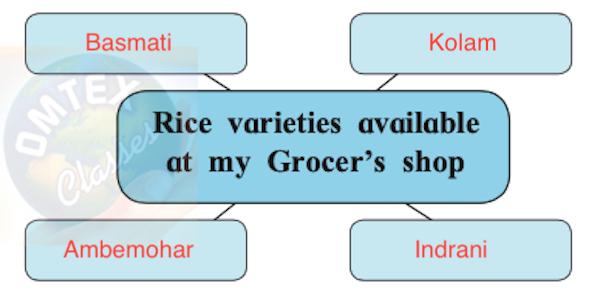
Activity:- Complete the following web diagram :


Rice varieties available at my Grocer’s shop

Complete the following web diagram:


Complete the following web diagram.

Chapter 1.3: The Call of the Soil Balbharati solutions for English Yuvakbharati 11th Standard Maharashtra State Board

Solution

Chapter 1.3: The Call of the Soil Balbharati solutions for English Yuvakbharati 11th Standard Maharashtra State Board


Activity:- Find out from your grandparents or parents the names of vegetables and fruits they had eaten in their childhood and mention how the vegetables and fruits are different from the ones today.


Name of the vegetables or fruit 

Shape

Colour

Taste

Mango

Oval, heart shaped

Green – yellow

Sweet

Banana

C - shape

Green - yellow

Sweet

Lady’s finger

Oblong

Green

Crunchy 


Activity:- You might have learnt about organic farming. Make groups and discuss the difference between conventional farming and organic farming and write it down.


Sr. No.

Conventional Farming

Organic Farming

1

Produce larger quantities of food

Produce lesser quantities of food

2

Less manual labour

More manual labour

3

Extra use of chemicals and pesticides may affect eco system

More ecological and good for health


Activity :- 1) Guess the meaning of the word ‘lush’ in this context.

Answer:- Meaning of the word ‘lush’:- rich, prolific or luxuriant


Activity :-2) Find words related to agriculture.

Answer:- Words related to agriculture:- green pods, crop, farmer, sowing, seeds, plough, farming, tractor, yield, chemical sprays, fertilizers, hybrid and desi variety, rice, moong etc.


Activity :-3) The write disagreed with Moru Dada because-------

Answer:- He did not want to spray some pesticides on the plants to give a higher yield. He did not think that it was essential to use such chemicals.


Activity :-4) The writer wanted to grow the traditional variety of rice because----1)------2)-----

Answer:- 

1) The traditional varieties were quite strong and resisted pests. 

2) They did not need very high inputs of fertilizers.


Activity :-5) The writer almost gave up hope of finding the desi variety of rice because----

Answer:- Most of the farmers in and around the village of Peth had switched over to hybrids. The younger generation of farmers considered planting desi variety as crazy thing. Writer’s visits to the villages around searching for a good traditional variety also did not give any results so the he almost gave up hope of finding the desi variety of rice.


Activity :-6) Mention the varieties of rice from the passage.

Answer:- 1) Kasbai     2) Basmati


Activity :-7) List ways in which the Government officer cooperated with the author.

            1)----------------2)-----------3)--------------

Answer:- 

1) Gave the names of a number of latest hybrid varieties.

2) Offered to give the writer some of the latest varieties free of cost for a trial.

3) Asked not to believe on the words of the villagers.


Activity :- 8) Find synonyms for ‘insipid’.

Answer:- tasteless or flavourless.


Brainstorming

(A1) (i) Read the extract and state whether the following statements are true or false. Correct the false statements.


(a) Growing in abundance is more important than the quality of the crop.

Answer:- False : Quality should be given more important.


(b) The author wanted to grow the desi variety of rice.

Answer:- True


(c) The author did not succeed in finding Kasbai.

Answer:- False : The author finally succeeded in finding Kasbai at Asarvari village.


(d) The aroma of the ‘desi’ rice would spread around the village.

Answer:- True


(e) Newer hybrid crops have a great appetite for chemicals.

Answer:- True


(f) The author is an example of ‘reverse migration’.

Answer:- True


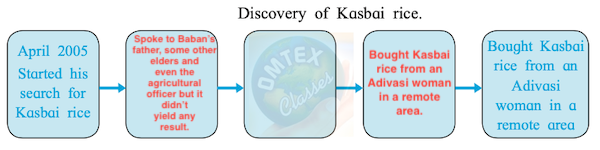
Activity:- Complete the flowchart. Consider this as an example of


Note-Making.

Discovery of Kasbai rice.


Discovery of Kasbai rice.

Activity :- Read the text and fill in the blanks. One is done for you.

(a) The author wanted to grow organic moong.


(b) Moru Dada wanted to spray pesticides on the moong crop.


(c) Baban’s father and some elders mentioned the name of Kasbai, the desi rice variety.


(d) “Hybrids need more water, fertilizers and pesticides”, said Devu Handa.


(e) The author bought 10 kilos of rice from an Adivasi woman who lived in remote hills.


Chapter 1.3: The Call of the Soil

Balbharati solutions for English Yuvakbharati 11th Standard Maharashtra State Board

Discuss the following with your partner and complete the following sentence.

Before eating apples brought from the market, I wash and peel them off ____________________.

Solution

Before eating apples brought from the market, I wash and peel them off because the outer layer of the apple contains wax coating.


In a farmers’ market, we find _______________.

Solution

In a farmers’ market, we find seeds, fertilizers, pesticides, etc.


Food adulteration means _________________.

Solution

Food adulteration means the addition of other substances that degrade the quality of food.


Organic food is grown by using __________________.

Solution

Organic food is grown by using organic seeds and traditional methods.


Organic fertilizer means ______________.

Solution

Organic fertilizer means manure/plant compost.


Complete the following web diagram.

Chapter 1.3: The Call of the Soil Balbharati solutions for English Yuvakbharati 11th Standard Maharashtra State Board

Solution

Chapter 1.3: The Call of the Soil Balbharati solutions for English Yuvakbharati 11th Standard Maharashtra State Board


Find out from your grandparents or parents the names of vegetables and fruits they had eaten in their childhood and mention how the vegetables and fruits are different from the one's today.

Chapter 1.3: The Call of the Soil Balbharati solutions for English Yuvakbharati 11th Standard Maharashtra State Board

Solution


Name of the vegetable or fruit

Shape

Colour

Taste

1. Mango

Round, Oval

Yellow

Sweet

2. Banana

curved

Yellow

less sweet, depending on the variety

3. Plum

Round or Oval

reddish-purple, yellow, Red

sweet to tart

4. Amla

spherical

light-greenish yellow

sour and bitter


You might have learned about organic farming. Make groups and discuss the difference between conventional farming and organic farming and write it down.

Chapter 1.3: The Call of the Soil Balbharati solutions for English Yuvakbharati 11th Standard Maharashtra State Board

Solution

Sr.No.

Conventional Farming

Organic Farming

1.

Pesticides may be used.

Strict restrictions on the use of pesticides.

2.

Fertilizers are used for better yield.

Natural fertilizers are used.

3.

Engineered methods for a quick harvest.

Natural growth is encouraged.

4.

Gradually deteriorates the fertility of soil and crop yield.

Improves the fertility of the soil.


Read the extract and state whether the following statement is true or false. Correct the false statement.


Growing in abundance is more important than the quality of the crop.

Options

True

False

Solution

Growing in abundance is more important than the quality of the crop - False.

Explanation:

According to the author, the quality of the crop is more important than its quantity.


The author wanted to grow the desi variety of rice.

Options

True

False


The author did not succeed in finding Kasbai.

Options

True

False

Solution

The author did not succeed in finding Kasbai - False.

Explanation:

The author succeeded in finding Kasbai but with great difficulty.


The aroma of the ‘desi’ rice would spread around the village.

Options

True

False


Newer hybrid crops have a great appetite for chemicals.

True

False


The author is an example of ‘reverse migration’.

True

False


Complete the flowchart. Consider this as an example of Note-Making.

Chapter 1.3: The Call of the Soil Balbharati solutions for English Yuvakbharati 11th Standard Maharashtra State Board


Solution


Chapter 1.3: The Call of the Soil Balbharati solutions for English Yuvakbharati 11th Standard Maharashtra State Board


Fill in the blank.


The author wanted to grow ______________.

Solution

The author wanted to grow organic moong.


Moru Dada wanted to spray __________ on the moong crop.

Solution

Moru Dada wanted to spray pesticides on the moong crop.


Baban’s father and some elders mentioned the name of __________.

Solution

Baban’s father and some elders mentioned the name of Kasbai.


“Hybrids need more _____________”, said Devu Handa.

Solution

“Hybrids need more water, fertilizers, and pesticides”, said Devu Handa.


The author bought _______________ kilos of rice from an Adivasi woman who lived in remote hills.

Solution

The author bought ten kilos of rice from an Adivasi woman who lived in remote hills.


List the reactions of the agricultural officer to the author’s inquiry about Kasbai rice seeds. One is done for you.

(a) He had not heard of Kasbai.

(b) ___________________________

(c) ___________________________


Solution

1. He had not heard of kasbai rice seeds.

2. He uttered the names of latest hybrids.

3. He also offered to give the author some hybrid seeds free of cost.


Go through the text once again and note down Devu Handa’s fond memories of Kasbai in your exercise book. One is done for you.

Devu Handa has fond memories of Kasbai. They are as follows!

(a) It needs ______________ rain.

(b) _________________

(c) _________________


Solution

It needs less rain.

It has an alluring aroma.

It is a long duration of rice.


The writer says he grew ‘an awful lot of moong’. Explain the word 'awful' in this sentence.

Solution

The word 'awful' in this context means 'a large amount.'


The word scent is different from its synonyms aroma, fragrance, or perfume. Explain how the word 'scent' in the subtitle ‘Scent of the Rice’, has a deeper meaning than ‘perfume’ or ‘fragrance’. Tick phrases having a similar meaning from the following:

In pursuit of

To smell a rat

To be keen

On the trail of

To feel under the weather


Solution

The word 'scent' in the title 'Scent of the Rice', carries a feeling within itself. It suggests a sense of belongingness. Also, it refers to the tracing of smell and hence, it is different from its synonyms 'perfume' and 'fragrance' in this context.

The phrases having a similar meaning are:

in pursuit of

on the trail of


Read the following sentence:

(i) She muttered in reply and we looked at Jeevan for a quick interpretation.

(ii) These are two complete sentences underlying the above sentence.


a. She muttered in reply.

b. We looked at Jeevan for a quick interpretation.


These two sentences are put together by using the coordinating conjunction ‘and’.

Such sentences are joined by coordinating conjunctions (and/ but/ either...or; neither...nor) are called compound sentences.

Sentence ‘a’ and ‘b’ are Simple Sentences.

Each of them has only one subject and one predicate.

Sentence ‘a’ and ‘b’ can be written in another way.

As she muttered in reply, we looked at Jeevan for a quick interpretation.

This sentence begins with a subordinating conjunction ‘As’.

This is a complex sentence.

Two simple sentences joined by subordinate conjunctions are called complex sentences. The subordinate conjunction need not always be at the beginning of the sentence.


Make pairs and groups and find out some more simple, complex, and compound sentences from the text.


Solution


Simple – It was April 2004.

Compound – It was just before sunrise and the sky was turning a bright orange.

Complex – I stood watching the sunrise above the towering trees across the fence and slowly made my way back to the house, a white structure in the middle of this greenery.


Prepare a list of subordinating conjunctions.


Solution

but, and, than, that, which, when, who, as much as, etc.


Planting and growing more crops a year seems to be progressed by normal standards, but the chapter makes a case against it. Give reasons.


Solution

According to normal standards, growing more crops a year is indeed progressive but the chapter makes a case against it because, in the name of progress, we are being fed hybrid crops and adulterated food items. We are inching towards illnesses and poor health with pesticide infested products and artificial agricultural enhancers. This will only lead to health risks.


Describe in about 150 words your experience similar to the writer’s when you pursued something and reached your goal.


Solution

I wanted to pursue Warli painting classes, but could not find any professional artist near my residence to coach me. I looked for online classes but failed in that attempt too. I asked my friends to check near their residential areas in and around Mumbai, still I failed to gather any positive news. Finally, one fine morning, while I was travelling back from college, I met a middleaged lady who was carrying a handbag with Warli artwork on it. I was instantly drawn to that bag and she noticed my expression. She ended up asking me about my interest in her bag. I was embarrassed at first but then told her about my love for Warli painting. She had a smile on her face. She told me that she belonged to Palghar district and that her forefathers dealt in that art. My happiness knew no bounds when at last, I got to know that I could take classes from her, starting from the upcoming Sunday.


The writer goes in search of an invaluable indigenous variety of seeds. List three reasons for the importance of keeping records of our indigenous agricultural practices


Solution

The following are the reasons for keeping records of our indigenous agricultural practices:

to compare traditional farming practices with conventional farming.

to compare the fertility of land after each harvest that has been done using modern technology.

to maintain and safeguard agricultural productivity based on utility.


Write a blog in about 100 to 150 words on organic farming.

Solution

Chapter 1.3: The Call of the Soil Balbharati solutions for English Yuvakbharati 11th Standard Maharashtra State Board


Write a short paragraph in about 120 words, to be used as Counter-View for the following topic. 'Buy a bigger cloth for your coat'.

View Section:

We cannot survive by the dictum 'Cut your cloth according to your coat' in today's world.

In the modern world, we should 'Think Big'.

Think of increasing your income instead of reducing your needs.

We can not deny ourselves, what the new world offers us.


Solution

We should always wear what fits our size, nothing more; nothing less. Thinking big is the need of the hour; not wearing bigger clothes! To think big doesn't just mean to live a king-size life and waste money on luxuries. Thinking big in rational terms means thinking for others too. Reducing your daily needs, cutting down on luxuries, and focusing on basic requirements will help take care of other‟s needs. Not just that, it will help to save resources for the use of future generations. The new world has a lot to offer, but we should know the limit and draw a line where our needs meet and our greed ends. This will only pave way for a happy and fulfilling life.


'Organic farming is the need of the time'. Write your views in favour of and against the statement.

Chapter 1.3: The Call of the Soil Balbharati solutions for English Yuvakbharati 11th Standard Maharashtra State Board


Solution


Views 


Counterviews

1.

Organic farming uses natural methods of growing food and is hence safe.

1.

Organic farming focuses on quality rather than quantity; which ensures a healthy lifestyle for the people.

2.

Organic produce is free of any chemical/pesticide and is therefore healthy for us.

2.

Organic farming is solely based on traditional methods whereas the seasonal changes and weather conditions nowadays require modern ways of farming for greater scale production.

3.

Organic farm produce is grown using manure and plant compost rather than other chemical fertilisers and thereby reduces the risk of cancer.

3.

Based on the ever-decreasing fertility of the soil, chemically enhanced fertilisers are required for better growth of the crops.

4.

Organic farming helps improve the soil‟s fertility, which helps to grow other crops.

4.

With an increase in the number of pest attacks and a constant rise in the consumption of food; protecting the crops against pests becomes crucial, which calls for the use of pesticides with upgraded strength.


Appeal to your classmates to say 'No to Junk Food'. Write an appeal to prefer organic food over junk food.

Solution


Don't eat junk food because it can cause many health issues like: 


  • Obesity

  • Gastrointestinal Problems. 

  • Heart Problems


Choose your health over convenience and go the organic way!


Plant the seed of a flower or fruit of your choice in a pot or in your garden. Note its growth every day and maintain a diary recording its progress.


Solution

Students are expected to attempt the above activities on their own.


Find out more career opportunities in the field of agriculture, organic farming, sales, storage, distribution, and marketing research.

Chapter 1.3: The Call of the Soil Balbharati solutions for English Yuvakbharati 11th Standard Maharashtra State Board

Solution: 

Students are expected to attempt the above activities on their own.


11th Standard English Yuvakbharati Balbharati Solutions for  Maharashtra State Board

FYJC English Latest Syllabus 2020 - 2021

Balbharati Solutions for English Yuvakbharati 11th Standard Maharashtra State Board Chapterwise List

The answers for the Balbharati books are the best study material for students. These Balbharati Solutions for English Yuvakbharati 11th Standard Maharashtra State Board will help students understand the concepts better.

Chapter 1.1: Being Neighborly

Chapter 1.2: On To The Summit : We Reach The Top

Chapter 1.3: The Call of the Soil

Chapter 1.4: Pillars of Democracy

Chapter 1.5: Mrs. Adis

Chapter 1.6: Tiger Hills

Chapter 2.1: Cherry Tree

Chapter 2.2: The Sower

Chapter 2.3: There is Another Sky

Chapter 2.4: Upon Westminster Bridge

Chapter 2.5: Nose versus Eyes

Chapter 2.6: The Planners

Chapter 3.1: Expansion of Ideas

Chapter 3.2: Blog Writing

Chapter 3.3: E-mails

Chapter 3.4: Interview

Chapter 3.5: Film Review

Chapter 3.6: The Art of Compering

Chapter 4.1: History of English Drama

Chapter 4.2: The Rising of the Moon

Chapter 4.3: Extracts of Drama - (A) A Midsummer - Night's Dream

Chapter 4.3: Extracts of Drama - (B) An Enemy of the People


.